

One of my favourite film directors is David Fincher.
His volume of work is impressive, even though lately, he has failed to recapture some of the more profitable success of his yesteryears.
If I had to pick out my favourite Fincher film, it would be: The Girl with the Dragon Tattoo (2011). It was my first real exposure to his style, work and overall artistic direction in which he crafts his films. It’s also, arguably one of his most complete and cohesive works.
However, I’m not here to talk about his films per se. I can wrap that up in an IMPACT series later.
No, what I’m here to talk about is … my own style and appreciation for aesthetics, that aligns with Fincher.
One of the more interesting questions I’ve been exploring, as I am on the verge of owning my own camera, a Sony ZV-E10 Mark II, is my own style.
What do I like? What do I appreciate? What moves me and grabs my attention? If asked to frame a photo, what would I do?
This led me down a rabbit hole discussion with my friends about how they see the world, if asked to create a still photo. For them, they try to evoke a feeling they felt when they take a photo. The subject itself isn’t as crucial as their ability to edit after. They want the shot, so that they can use certain filters and pre-sets onto the photo after and invoke a feeling.
I have a different approach. If asked, I would rather not edit my photo afterwards at all.
About 80% of that reason is laziness. I’m only just starting to understand photography a bit more, (all meaningless research, as I have yet to receive my camera, let alone play with the settings) and the idea of getting an Adobe subscription to Lightroom or Photoshop to spend more time editing a photo is tiresome to me.
The other 20% though, is because I would rather take the Fincher approach. Appreciate an image in its cold, still beauty.
In what seems like a tiny dip into the pond of creating images, I still recall fondly playing around on my PS4, with Gran Turismo Sport (2017) photo mode.
I would spend hours placing my favourite cars in various different settings, tweaking their position, their location in the frame and trying to achieve a sense of speed in a still photo.
But the one thing I never really played with was the filters. I hated the colour combinations. To me, an image is perfect when it reflects reality. I don’t like seeing reality in a different lens. It reminds me of why I hated the trend of certain films to stick to a colour palette throughout the film because they are trying to invoke an exotic location.
Think Extraction (2020) with its yellow hues across the entire film, because it’s set in India or whenever a place tries to film in Mexico, the effect is this yellow tone throughout the entire film, ala Spectre (2015).
This isn’t to say that Fincher doesn’t play with his colours. He is famous for his desaturated colour palettes. The greys, blues, black and muted greens are famously part of his style.
Everything in his films is almost lifeless. The camera moves with a robotic precision, removing that famous technique of “shaky-cam” where you know a real breathing human is holding the camera to capture the shot.
The colours in his films are tonally cold, showing you the viewer, a more clinical way at looking at the world. His actors undergo, gruelling numbers of takes, up to 70 or more, to remove what he describes the “earnestness” from their acting.
Even the music, by his longtime friends and collaborators, Trent Reznor and Atticus Ross (Nine Inch Nails -NIN) is haunting, metronomic and eerie because of their lack of central theme and almost slavish conviction to capture a moment in the film, not sum up the entirety of the film with a grand overture.
It’s a cold way at looking at the world. Cynical, almost bleak and yet … it’s arresting.
Because everything looks incredibly good in his film. I personally love the almost abstract clinical way in which he looks at his films and art.
Another excellent example of this, is the cinematography of the show Hannibal (2013) which invokes that same eerie, cold beautiful aesthetic. Of course, one of the central themes of that show is to showcase the beauty that can be found in horror, something that I think Fincher can definitely relate to, considering the subject matter of so many of his works.
Hannibal has that same unsettling factor as Fincher films. Whether you are looking at corpses, beautifully prepared food, murder, conversations at the dinner table or nervous breakdowns from Will Graham, it’s all shot in a very aesthetically pleasing way, to almost convince you that there is something elegant and beautiful about the macabre.
I suppose it’s that refined elegance that I want to capture in my style. It ties in with my interest in architecture, how I love the Art Deco period and its use of circles and straight lines to dramatise certain features like columns and windows. That movement stir a similar feeling in me when I look at Mid-Century-Modern use of lines, a fascinating way of scaling everything back to almost simplistic basic uses of everything, without frills or additional embellishments.
So, this then begs the question, if I am truly all about my realistic, trimmed back aesthetic, where I see everything is almost like a machine would, except this machine could appreciate beauty somehow, what kind of photos would I take?
To me, my photos would largely be almost subject-less, or a moment where a person feels a part of the greater landscape than the primary focus.
I’ll try and capture the mood with my descriptions of certain shots or atmosphere in films I particularly like.
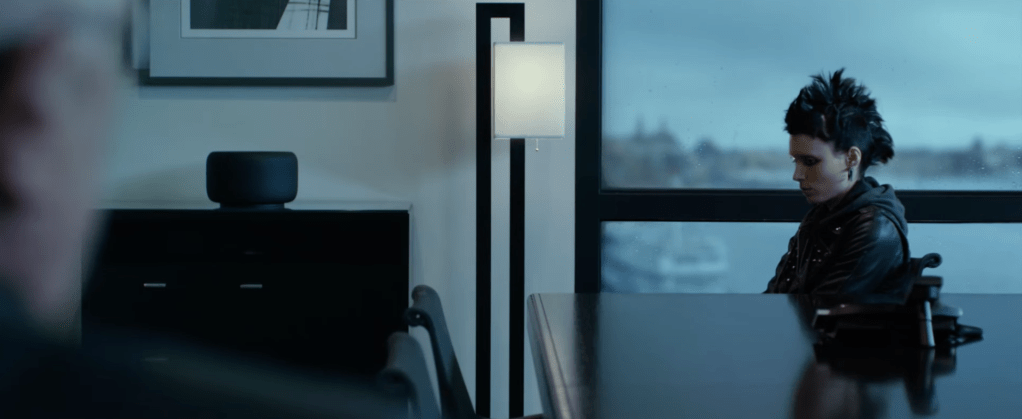
In The Girl with the Dragon Tattoo (2011), David Fincher elects to go with a very muted, cold, almost blue aesthetic to the film. Everything is incredibly clinical. The shot of Rooney Mara’s Lisbeth Salander when you see her face for the first time, is in profile, side on, to showcase her mohawk, against a clear sky, in a mundane office setting.
It is striking, memorable and deliberate in how Fincher framed the film’s protagonist for the first time. Lisbeth doesn’t belong in this corporate setting, she’s deliberately sitting apart from her superiors on the other end of the table and there’s an alien nature to her that makes her both weirdly attractive and incredibly off-putting.
I love this film for its muted, almost too real aesthetic. I love the idea that if I walk out into reality, I might see this type of image right there. It’s that exciting feeling of being able to recreate or experience a movie shot, that I’ve seen before, that I really treasure. I like my films being shot so similar to how I view the world, to make my own world more exciting.
F1 (2025) by the Joseph Kosinki is another example of a director whose style I’ve loved throughout every single film he’s done, from his breakout with Tron Legacy (2010), to his more underrated sci-fi thriller, Oblivion (2013), to his blockbuster Top Gun Maverick (2022).
F1, for all its faults (for which I have many), is a beautifully shot film. The cars look amazing, the shots of Pitt’s Sonny Hayes driving is incredibly immersive and the sound design is excellent. But my favourite scene by far, weren’t the F1 races.
As a guy who has volunteered as a track marshal for multiple Australian Grand Prixes now, I know how fast and also how incredibly boring F1 races are. The overtakes are minimal, the track action is dull beyond the first 5 laps and it becomes a parade really quickly.
But what I’ve always loved were the support races. I grew a whole new appreciation for the home-grown Supercars category, how fast, aggressive and angry they all are to each other. I became a massive fan of the Porsche Carrera Cup races, because they showcased the skill of every single driver and how it is possible to have good racing at Albert Park if everyone has equal machinery.
This love for the Porsche Carrera Cup, is exactly why I loved the 24hrs Daytona sequence at the very beginning of the film. When I saw the brake calipers light up, in the storm of fireworks, along the iconic cambered track of Daytona International Speedway, I knew that this film was cool. That shot of the brakes glowing red hot, is my favourite in the entire film, because it perfectly sums up what makes racing cool in my eyes.
Again, a shot, devoid of humans, but showcasing the beauty of small details that everyone misses in the grander scheme of things. That is the kind of shot I really love, getting in the granular details of things that would be underappreciated for their complexity and beauty. It reminds me so much of the chase camera that would be strapped to the side of the car, showcasing the intense revolutions of the tyres, along the speeding surface of the road in Miami Vice (1984).

Skyfall (2012) is arguably the best-looking Bond film in the entire franchise. The cinematography of Roger Deakins is immaculate, and the sheer clarity of the images I was seeing on screen, from the greys of London’s skies to the dark nights of Shanghai really sold to me the theory, that I preferred seeing things through my own eyes.
My favourite sequence in the entire film, from a pure aesthetic standpoint, is the entire time that Bond is in Shanghai. The way how Deakins captures the inherent urban beauty of Shanghai is just perfect. I loved the way how he utilises the reflection motif throughout the entire scene, starting with Bond sitting at a bar, awaiting orders and intel on when his target, Patrice would arrive at the airport. This is then echoed later, when they have their climatic showdown in a room full of mirrors, a beautifully shot scene with their silhouettes masking which agent is which.
But it was the opening B-roll of Shanghai that initially grabbed my attention. It was such a different aesthetic to the film prior, because we went from the dusty streets and train action scene of Istanbul to the cold, tunnels of London and now thrust into the new glittery metropolis of Shanghai.
The way how crystal clear Deakins shoots the nightlife of Shanghai is what I really adore about the scenes. It’s so clear, without the odd additional filters (Instanbul’s dusty yellow, London’s greys). Its again, clinically showing us what Shanghai actually looks like.
It also showcases the unique angles that only films can achieve, by slowing zooming in to a rooftop hotel pool that only has Bond swimming in it. His existence is lonely, in a city of 25 million people, and there are echoes of what I call the Lost in Translation (2003) effect, where you can feel isolated despite being surrounded by people.
The way how Shanghai was filmed, has now piqued my interest in visiting the city. I fell in love with the reflections, the clean lines, the shimmering lights because of the way how Deakins faithfully adapts to the film how the city actually looks.

What about then, if I had to take photos of people? After all people are a vital part of any photographs.
Through silhouettes is my default preference.
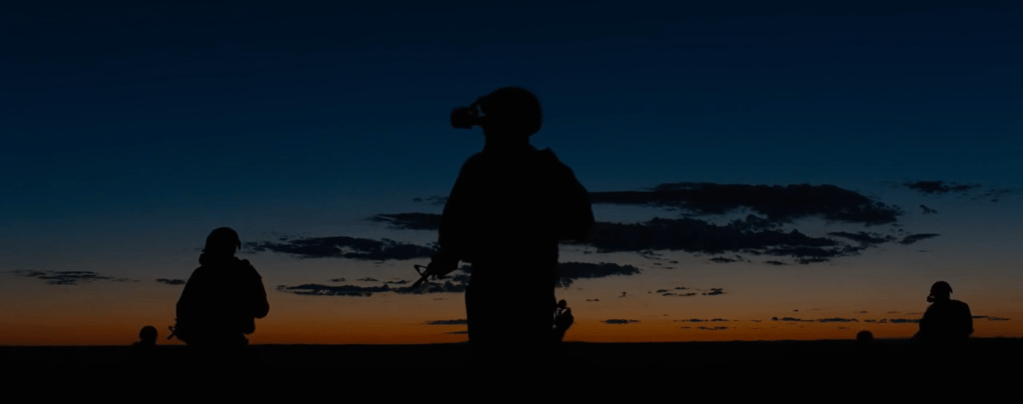
Sicario (2015) has one of the greatest use of sunsets I have ever seen placed onto film. The way how Roger Deakins uses the natural lighting of the area and timing of the sunset to captures the moment the soldiers descend into the darkness of the ground is incredibly evocative.
My jaw dropped when I first saw this scene because of how cinematic it was. It was an incredible display of visual storytelling at its finest and really sold to me, how much I love seeing things in their raw format, because nothing quite beats seeing something clearly, especially when you capture a moment like this.
I love the featureless elements of silhouettes. Ever since I was a kid, I’ve always loved seeing how my shadow moves in accordance with the sun, and much like everyone else, sometimes wondered if that shadow belonged to someone else, who just mimicking my movements.
It’s why certain images, like the iconic Mad Men (2007) silhouette promotional image, and shots like in Sicario feel more immersive to me, because I can just picture myself in that same moment. I like being able to pretend that it is me in that moment, walking towards the Mexican/American border, hunting for the cartel under the cover of night.
It also brings into light what I like about silhouettes … they are often candid shots. People doing something. I’ve always struggled with portraits and framing people in certain ways, because when they pose, there is an air of inauthenticity about the whole thing.
I can never get the arm positions to look natural, or to capture the smile just right. It’s inherently … false.
It also doesn’t help that my limited experience in photography stems from my course in photojournalism at university, where guerilla street photography is king, capturing candid moments almost like a paparazzi would.
Couple that with my events background, I’m definitely skewed towards candid photos. I love capturing raw moments but framed in such a way that offers context to why people are doing what they are doing and in a very clean, clear way.
In my mind, I can see the shots I want to take and often wish I could just take a photo with my eyes, because I see something worth capturing in the moment. Like when my girlfriend laughs a certain way, or when she is looking at something that puzzles her.
It’s those moments that feel real to me, and I don’t want to see a whole bunch of filters or other stuff that gets in the way and sully the rawness of the moment.
It’s why I can almost relate to Fincher’s insistence on doing so many takes. You want to remove the “poser” element out of the acting performance and get to the real essence. The actor has to disappear into the role in a sense so that everything they do, from breathing to the very words being spoken, are so natural that you forget an actor is there.
That sense of capturing a raw and real moment, through crystal clear cameras, is what I love about the cold beautiful aesthetics. Because there is a clinical appreciation for what is aesthetically attractive in front of you. It’s a strange marriage between art and science.
You’re trying to insert unfeeling precision into something that is inherently passionate.
Fincher once said in an interview, that “people are perverts”. It’s something that has stuck with me ever since. After all, there is always a sense of voyeurism about taking photos or creating films.
And people are social creatures. We love prying our noses into other people’s business and trying to work out why people do what they do.
Hell, even the basic question “How are you?” is inherently inquisitive. We always want updates on people we know, what they are up to, whether they have undergone any change.
Yet how we approach this “perversion” is everything.
At the end of the day, I like to treat it almost mechanically.
I know what moves me, and what I deem attractive. I’ve always had a very clear vision on this.
I think it’s important that I know what I appreciate as art and what I don’t. Because at the end of the day, if you can’t decide on whether something is attractive to you, then you can’t define what is unattractive.
It’s why I have a clear disdain for a lot of contemporary art. All of it is drivel to me. I have no interest in it. If I need a paragraph to explain something visual … then it’s failed to do it’s job.
I don’t need a written or oral speech on how a banana taped to a wall is indicative of something deeper.
It’s not. It’s a fucking banana taped to a wall, that has zero merit. It has zero artistic value to me, because I’ve never thought a banana as attractive, or tape on its own, nor a blank wall …. or the entire combination of the three.
This dismissive attitude then frees me up to look for something I do like. I can explore the why behind the things I do like. Whether that’d be a French Impressionist landscape or the way how my girlfriend’s lashes flutter on my chest, I can look deeper into those moments because I find they have value.
Photography is a way to express my appreciation for what I find attractive, just like it is for millions of photographers out there. But we all differ in how we capture aesthetics.
For me, part of my aesthetics is to capture what I see through my eyes. I’m not interested in “distorting” or “editing” the photos beyond what I see. It’s a very rational, deep appreciation for what I already view out there. It’s about capturing something in the moment, when everything is aligned …. subject, lighting, framing and mood.
I’m almost objectively trying to capture something aesthetically pleasing.
It’s a process that is mechanical, clinical and almost unfeeling, so that there can be no arguments that I tried to make something beautiful, more or less than it is.
You are almost forced to admit that what I capture is pleasing, because you know that I didn’t try to enhance the image in any way.
This is what I mean, when I try to describe my preference for cold, beautiful aesthetics.
It’s why I love the cinematography of Fincher films and those similar to him, like Joseph Kosinski or even Denis Villeneuve. They’re calculated and precise in how they frame images and present them. Their cameras move very smoothly, to remove the human element behind them. Very little is done to touch up the image itself. Their score is minimalist to enhance the mood of the scene, rather than distract.
Of course, there will always be a love for more bombastic styles. I appreciate the need for other techniques in other films and admire them as well. Daredevil’s use of a hallway oner, John William’s use of horns, Michael Bay’s iconic 360 sweep or the overacting of Nicolas Cage. The necessary inclusion to duel-wield Berettas in John Woo movies, the shaky-cam documentary style of Paul Greengrass, the dry, functional smoky aesthetics of Soderbergh films … the list goes on and on.
But I love seeing something so clear, that I can go out into Shanghai and experience that bar scene for myself.
Reality is already glamorous. You don’t need to touch it up more.
Instead, I just want to capture it in a raw a format as I can.
Candidly but with as much precision as I can muster in that moment.
Imagine taking a photo so perfect, that everyone who looks at it, is forced to admit …. it’s perfect.
That is the underlying philosophy behind cold beautiful aesthetics and why I love it.
~ Damocles

 Damocles' Journal