
Y/N? Yes
Stars: Timothee Chalamet, Rebecca Ferguson, Austin Butler, Josh Brolin, Stellan Skarsgard, Dave Bautista, Zendaya, Javier Bardem and Florence Pugh.
Director: Denis Villeneuve
Review by Damocles.
It deserves to be watched in one sitting.
Denis Villeneuve continues to be one of the best directors working today with this conclusion to the Dune duology. There is a breathtaking confidence to the shots he emphasises, the crescendos in the plot he chooses and the character moments that are given plenty of time to shine. This is a filmmaker who has absolute faith in the project he is directing, and the film shines because of it.
As a film, Dune Part Two, is a masterpiece in how to make cinema. This is a rare film, able to balance high sci-fi concepts, make it palatable to audiences en masse and faithfully stay true to the source material whilst imparting a unique flair and vision to it all. The last great sci fi film that captured audiences so well, was probably Avatar, but that was never trying to adapt a beloved book series and lore.
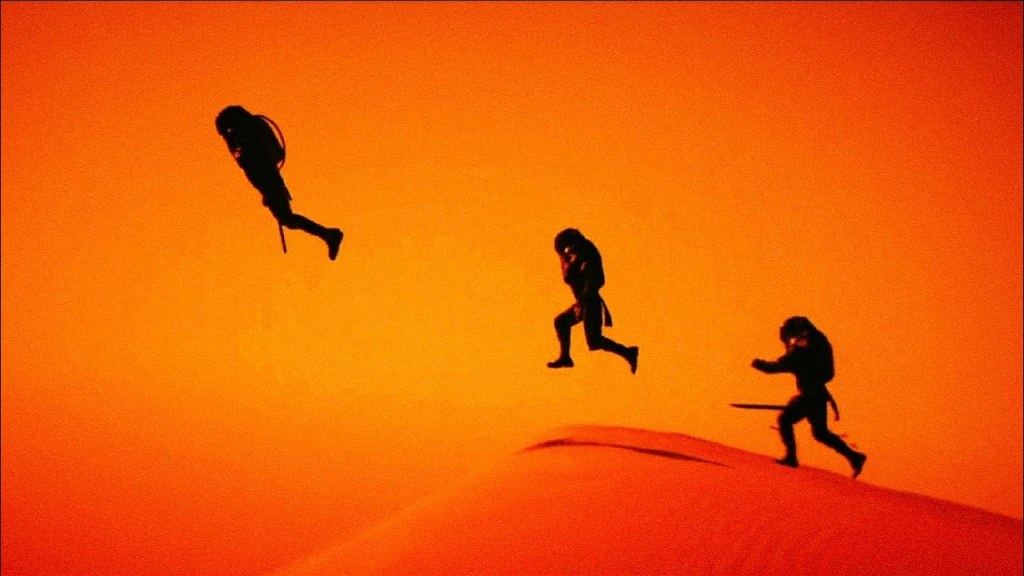
The moment early in the film, when the camera widened out, to showcase the anti-grav technology of the Harkonnens floating in the air, in a strange, eerie manner was the moment I knew that I was witnessing something special.
This is the definitive version of Dune. The visuals, the costumes, the score, the actors, the story, the characters … they will forever be enshrined as how people read and visualise Frank Herbert’s novel. In many ways, this feeling of seeing how strong Denis’ visual interpretation of the novel has taken over the version in my brain when reading the novel, reminds me of the early Harry Potter novels.
The film crew simply nailed everything on the head. I will never not see Daniel Radcliffe as Harry Potter, nor imagine Hogwarts any different to how the films first showcased to me as a child.
Denis’ vision for Dune has proved that I will never see Paul Atreides as anyone else than Timothee Chamalet nor imagine the landscape of Dune as anything other than the clean, almost sterile aesthetics of these two movies.
In a lot of ways, Dune needed to be adapted by a filmmaker who was obsessed with the lore and had the budget to do so. It has remained infamously difficult to adapt, because of the numerous strange sci-fi concepts and the fact that it is such a strange, contradictory world for audiences to jump into.
The idea that space-travel is only possible through “spice” and that bladed weapons and feudal society exists in a galaxy that has mastered space flight runs counter-intuitive to how so many other sci-fi universes interpret their world. But that is the genius behind Villeneuve’s adaptation. He is able to take these highbrow concepts, distil them down to their essence and allow audiences to understand what is happening.
That is why I now understand the pace of the first Dune film. It had to be slow, methodical and less action-packed, because audiences had to slowly grasp everything that Dune was about. The importance of “spice”, the significance of Arrakis, the shadowy politics of the Great Houses and the Bene Gesserit … all of these elements had to be well established so that Dune Part Two could run.
And run it did. The film is much faster paced, with a bigger focus on action scenes and the romance between Paul and Chani. The action that I craved from the first movie, was immediately satisfied with the very opening sequence, as Paul and the Fremen escape from the Harkonnens and begin the journey of revenge.
The film has to be commended for its pace. Dune Part Two is an extremely measured film. It knows when exactly to speed up, when to slow down, and when to let scenes breathe, so that the audience become more engaged in the world that is being presented. Moments like the introduction of Feyd-Rautha on the Harkonnen home planet, the tender moments between Paul and Chani as their relationship grows, or the first time Paul rides a sandworm, are incredible story beats that are given as much time as they need in the film.
There is a deliberate slow-fast pace to the film, that makes it easy to watch. It moves at a jog rather than a sprint, and that is the perfect way to get hooked into the world of Dune.
The cast continue to do solid work, Timothee in particular, showcasing why his youthful looks, yet steely temperance is the perfect fit for Paul’s growth and character development. High praise must also be given to Florence Pugh’s small, but important role as the audience surrogate, Princess Irulan, into the mind of the Emperor. Her costume design is something I will touch on later, but is another reason why costuming is so important in film.
But the real fun highlight was Javier Bardem’s Stilgar. The once aloof Fremen leader, now transformed into a religious zealot and believer in the prophecy that Paul seemingly represents. He is the audience’s source of limited comic relief and a reflection of Paul’s dark journey. The growing obsession with Paul Muad’Dib is a beautiful religious allegory that is pulled off wonderfully by Bardem’s performance.
Now, onto the technical elements of the film that I love to explore.
From a cinematography perspective, Dune Part Two is an absolute marvel. The shots are immaculate and carefully chosen. There are some genuinely jaw-dropping shots that echo the general aesthetic of all Villeneuve films. The man, coupled with a master cinematographer in Grieg Fraser can literally do no wrong. Whether they are playing with colour, with reveals or simply setting the scene, the cinematography in Dune Part Two is incredible.
To complement such visual flair, the CGI in the film is equally impressive. Everything looks lived-in, believable and real, aided by things that look like they have actual physical weight and by impressive sound design. Dune never looked bad in any of the shots, a difficult feat to pull off in today’s crunch when it comes to VFX.
As for score, Zimmer continues to excel. His score had a stronger feel in this sequel than I expected, after hearing the first one. It’s thematically more folklore-like, with an emphasis on really punching in with the big moments. When listened together with the first film, it’s a fun, compelling audioscape.
But easily my favourite part of Dune is the costume design. Princess Irulan’s medieval, chain-mail aesthetic is incredibly cool when compared to the simpler robes and still-suits of the Fremen. There is an untouchable air to her, that is only visually enhanced by her cold, shiny, metallic mesh and veil. It’s perhaps the most unique take on a princess I have ever seen on film.
The same could be said for Emperor Shaddam Corrino IV, played by Christopher Walken. His simple white robes, lack of gaudy finery only enhances the frail nature of his rule and the fact that he is an ineffective ruler. But by far, my favourite element are all the armour sets featured in both films. From the Harkonnen’s all black suits, to the Atreides larger grey armour, and to my favourite Sardaukar’s white/grey combination, the interpretation of medieval armour into a near-future sci-fi, is just amazing.
Overall, it’s hard to not miss the phenomenon that is Dune. Whether you follow fashion, in which Zendaya showcased her perfect taste and range on the red carpet, or just enjoy cinema, Dune is easily one of the best films to come out in recent memory.
It’s enthralling, captivating cinema and I honestly cannot wait to see what Denis Villeneuve does next. I truly hope he continues to adapt sci-fi and explore more elements of the human experience, in the thoughtful, cinematic way, he is so uniquely suited for.
If you haven’t seen Dune yet … put it on the biggest screen you own.
A scene to recall: The opening action scene where the Harkonnen are hunting Paul and the Fremen. The orange backdrop, that is contrasted by the black inhuman armour of the Harkonnen is just visually stunning. It’s also amazing to hear the Harkonnen language being used so gutturally and shows why the Fremen are a force to be reckoned with.

 Damocles' Journal