
Peer to Peer Warfare
AFGHANISTAN – AFGH
In my opinion, the modern Warfighter mentality and ethos has been shaped by one environment in particular: the mountains and people of Afghanistan.
The region of Afghanistan has invariably marked every single Western warrior that has heard of or step foot on its soil. There have been numerous new advances in war-fighting since the war began in 2001. Here are a few examples:
New modern camouflage patterns have emerged, i.e., the death of digital camouflage in favour of the more ubiquitous “multicam”. The base colours of multicam have their origins from Afghanistan, due to the highly varied biomes in the country. You can go from lush green fields to ice-white arctic conditions in the mountains and then come home in pitch darkness. Camouflage had to change and now multicam is the new uniform for NATO troops.
Newer, slower, more cautious CQB tactics have been developed so that soldiers no longer do “dynamic” entries into doors. Gone are the days when soldiers would kick in doors, throw in flash-bangs and then storm in with multiple bodies into a room. Now, troopers “pie” or “slice” doorways, wary of booby traps, suicide bombers and the “fatal funnel.” The simple fact is … armed forces are now unwilling to rush into danger, instead being more methodical and slower in their approach to room clearings.
Music that once defined warfare, the heavy rock inspired soundtrack to the Vietnam War has now been swapped out for Middle Eastern ouds and a distinctive tragic heroic melody that infuses all pop culture surrounding the Global War on Terror.
Iconic weapon systems, such as the venerable M16 rifle became shorter, quieter and more expensive. The legendary Heckler & Koch 416, first adopted by the equally mythological United States Army’s Delta Force or CAG, was the apex of AR-15 development, a weapon system that was modular, reliable and pinpoint accurate. The accessories that were found on these rifles, cost almost as much as the gun itself; EOTECH holographic sights, magnifiers, AN/PEQ-15 NGALs, fore-grips, SureFire suppressors, torches and custom slings.
The age of modularity and the varied environments these soldiers found themselves fighting the Taliban in, created a gun culture in which everything could be swapped out. The glory behind HK 416’s crowning moment, the death of Usama Bin Laden, lasted only for a few years, before the new do-it-all weapon platform came along, the sleek SIG Sauer MCX family of rifles. A rifle so proprietary and cutting edge that it became the latest new combat rifle for the U.S. Military, designated as the SIG MCX Spear and in a unique new round, the 6.8mm Creedmoor, replacing the famous 5.56x45mm NATO cartridge.
Even the modern formation of a “squad” has changed. What was once an elite team of Tier One Operators such as DEVGRU, CAG or SAS, are now saddled with additional personnel, such as JTACs, translators and even lawyers, men and women who cannot keep up with the physical abilities of these elite soldiers and thus hinder these men on their missions.
But that is the cost of guerilla warfare.
Laws must be upheld, updated and reinforced across all branches of the military. When you are dealing with civilians who can be friend or foe depending on the season and whether you have recently stepped foot on their farm, the rules of engagement for modern soldiers can get extremely murky. Discretion is the better part of valour, but that is a difficult skill, that can only be garnered through harsh experience.
It seems that whenever a technologically superior force comes up against the people of Afghanistan, the superior force loses. It is not nicknamed the “graveyard of empires” for nothing. Alexander, the British, the Soviets and now the Americans … all of them have failed to conquer the country and its hardy people and subsequently became a shadow of their former self after their withdrawal. The infamous mujahideen reputation of the Afghan people proves that they are not above playing the long game and winning out. After all, the Americans were there since the 7th of October 2001 and they retreated on the 30th of August 2021. That is almost two decades of fighting and like the rest of the world, I was astonished at how quickly the Taliban re-seized the country.
But as the son of a Vietnamese refugee family, that shouldn’t have surprised me. After all, the Fall of Saigon was just as swift, when the Americans left the country and there were echoes of history repeating the failure of American foreign policy in the frantic evacuation in Kabul airport.
However, I am here to discuss how Afghanistan has formed the new identity of the modern Western Warfighter. As an avid student of warfare, I noted the explosion of interest in Special Forces in the zeitgeist when it came to discussing armed forces. In particular, the new fascination with U.S. Navy SEALs (Sea, Air Land).
There is a common misnomer about the SEALs that I must get off my chest. To earn the famous trident pin, new recruits are put through the famous BUD/s program, a gruelling test of physical and mental fitness and stamina and capability. However, upon graduation, and earning your trident, you are no more special than a U.S. Army Ranger who passed Ranger School or a Royal Marine Commando who passed the Royal Marine Commando Training.
Talented, special and deadly yes, but you are not the true tip of the spear that the media portrays the SEALs to be. That would be the Tier One unit within the SEALs community known as DEVGRU (Naval Special Warfare Development Group) or SEAL Team Six.
Moving on from that pet peeve, the proliferation of SEALs in popular culture is what has led to an exponential growth in the tactical community. There is now more information about CQB, weapon set-ups, EDC lessons than ever before. The plethora of autobiographical books, films and podcasts about SEALs (No Easy Day, Lone Survivor, American Sniper, The Terminal List, Jocko Willink podcast, the Shawn Ryan Show to name a few) has created a modern-day myth around the men who earned their trident pin abroad and domestically.
Unfortunately, this has created an aura of invincibility around the concept of modern war-fighting. After all, it is difficult to not buy into the hype that if you are armed with a “Gucci AR-15”, dripping with the latest technology, a pair of NVGs (night vision goggles) and proudly wearing a plate carrier, you are likely to come out on top of any firefight you get into. But the key fact here, the evidence that brutally undercuts all this idolisation of Special Forces is … Americans have been fighting guerillas for most of their modern history.
Under-equipped, disparate, terrorists who hide in caves, tunnels and civilians. Whether it be in 1989 Panama, 1965 Vietnam, 2001 Afghanistan or 2003 Iraq … American war history is defined by their superior technology and equipment clashing with poorly armed terrorists.
(and they lost all of those wars)
The wars they fought in were not peer to peer.
Peer to peer conflict is the worst type of conflict imaginable. When two equally well equipped, armed and motivated forces clash, there are no winners, regardless of how good your equipment is.
The individual soldier does not matter on a field where everyone has artillery, drones, K9s, planes, tanks and training. Warfare is now much, much more lethal. The SEAL, the CAG, the SAS trooper is no longer the invincible super soldier that media has mythologised. After all, the enemy on the other side has just as much expensive equipment, support and training as they do.
When you are hunting down a terrorist in an Afghan cave, a Mexican tunnel or on the streets of Pakistan, the onus in on you, as a soldier. You need to have better kit to catch these smaller forces. After all, you represent the spear now. You can’t just use a guided missile to take out this small group of armed men. Hence, men are needed to fight men.
But in Ukraine … none of that matters anymore.
Why send men to fight men, when you can shell them from kilometres away with artillery?
Why walk over to the trench, when you can purchase a cheap drone off Amazon, load a few grenades on it and simply fly over and drop the live explosives on the enemy?
When the entire country is the enemy … the scalpel loses its appeal and it’s time for the saw.
Or in Russia’s case, they tossed the sickle aside and unleashed the hammer.
UKRAINE – UKR
The sheer amount of information about Ukraine is staggering. Reddit, Twitter, Instagram, YouTube … the internet is awash with intel regarding the latest peer to peer conflict to envelope Eastern Europe.
Learning more about the war has been the biggest ego-check any mil-simp like myself has received.
After all, I grew up on the culture and climate of the Global War on Terror (GWOT), where the emphasis was on Special Forces doing the majority of the work. I made the incredible fallacy of believing the hype surrounding these men, that a single platoon of SEALs were all you needed to fight a war.
But the truth of the matter was, a single platoon of SEALs was all you needed for a hunt.
There should be an attitude change regarding GWOT.
It wasn’t a war.
It was a glorified hunt for vengeance.
What is happening in Ukraine is a bonafide real war, where the real backbone of any military, the infantry, the common fighting man, is the true strength behind the war effort. Bodies are needed to replace the wounded and the dead and warfare has turned into a numbers game.
As a General, you do not need the most specialised troops to storm a front. You need men, who are adequately trained to a basic, effective level, armed with simple gear and be motivated enough to follow orders, regardless of how brazen, dangerous and terrifying they are.
Gone is the appreciation for the scalpel like precision offered by Special Forces.
Now, in a peer-to-peer conflict, it is about seizing the moment, pressing forward the advantage through any means necessary and then subsequently holding that precious gained ground against counter-attack.
Warfare, once defined by its huge complications in wielding massive logistical challenges against inferior forces has now boiled down to a much more primitive version as seen in the early 20th Century.
For example, when storming an insurgent stronghold, NATO forces will need guaranteed support from a multitude of fixed-wing or rotary CAS (Close Air Support), a QRF (Quick Reaction Force), medevac and real-time satellite imagery with a host of HQ support suites from drones, artillery, mortar to communications.
What this looks like in reality, is an absolute bedlam of controlled chaos. A platoon of CAG troopers on the ground, before even storming the compound, will have their CAS: either a fleet of AH-64D Apache Longbow helicopters buzzing overhead or gun-runs from A-10 Warthogs, or an AC-130 Spooky Gunship circling overhead. To control all these airborne vehicles, there will be an AWACs high above all of these angry hornets, to mitigate any of these elements from shooting one another or crashing mid-air.
Then there will be a battalion of U.S. Army Rangers supporting the Delta platoon, acting as their QRF, which means establishing a perimeter to prevent any escapees as well as back-up for the Delta boys in case they get injured or overwhelmed.
Throw in a couple billions of dollars’ worth of satellites, indirect fire from Ranger mortar teams or artillery units and at long last the much vaunted American “scalpel” is ready to remove a terrorist stronghold off the face of the earth.
One bad-guy stronghold, of maybe 30-50 fighters inside.
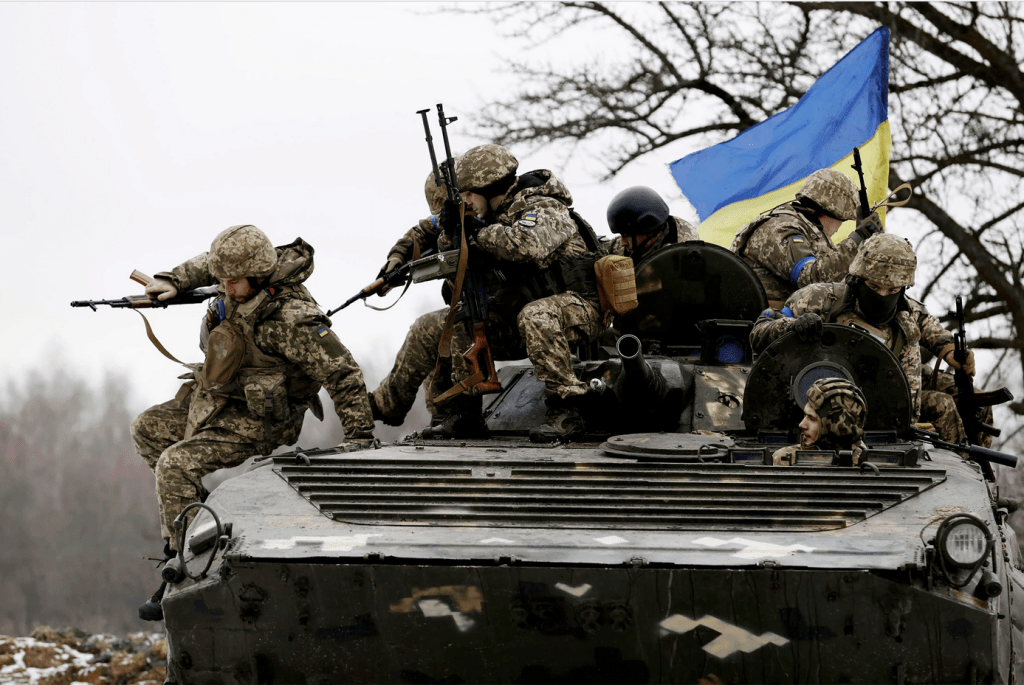
Now imagine you are an Ukrainian conscript.
You signed up, because the dastardly Russians have invaded your home country. You are looking out over no-man’s land, where kilometres of mines, entrenched positions, defensive barriers and enemy artillery fire is waiting for you.
The Russians are waiting.
You look down, at your simple AK-74 rifle, with its wooden stock, iron sights and orange Bakelite magazine. You do not have thousands of dollars’ worth of optics that allow you to see and shoot more accurately and further, nor is there a fancy laser sight that you can use to aim, instead of squinting down the receiver of your decades old gun.
Your uniform is rugged but old, enough to keep the chill out but itchy. It’s the same colour as the ground, a miasma of green, brown and black. Your boots are soaked in the waterlogged trench, and you know that if you get shot in the head, the helmet you are wearing, is not enough to stop anything but artillery shrapnel.
When you look up, there is no reassuring heavy thuds from the rotors of the most advanced attack helicopter in the world, nor is there the telltale whirr from a gunship that has a tank cannon mounted in the side of its fuselage.
Instead, all you hear is the annoying insect like buzz from your comrade’s toy, a tiny cheap, white drone that has a Go-Pro camera taped to the bottom and a grenade with a stick through the pin.
There is no tablet that you can bring out and consult for a map, nor is there a five-star general barking orders into your ears, telling you where to go, who to shoot.
Even the tank situated 200 metres behind you, isn’t technically an “tank.” It’s an armoured personnel carrier, whose ammunition has run dry and is acting like a quasi-shield to protect the wounded. It’s barely offering any protection though, because the Russians have punched so many holes through its armour with their rockets and armour piercing rounds that it behaves more like a slow lumbering ambulance that soaks up bullets with every pick-up.
I am creating an exaggerated picture, but I strongly believe that this bleak image of their immediate future is what the common fighting man on both sides of the Ukrainian front is currently facing.
Peer to peer conflict has created this stalemate, a paralytic state of a war where both sides have the same capabilities and suddenly, all the advances in stealth fighters, attack helicopters, satellites and drones mean nothing and it’s back to the old ways of digging trenches and advancing slowly across bloody, muddy ground.
And I cannot think of anything more depressing and awful.
In a way, this situation reminds me of two key movies scenes that have always stuck with me for their impact and power when portraying the strangeness of war and its depressing nature.
The first is the literal first scene of Gladiator (2000), of Maximus’ hand running through the field, lingering and enjoying the prospect of life and peace. The warm yellow tones of the scene is immediately contrasted with the cold, dark, blues of Maximus’ character pondering the battle ahead. A bright yellow bird amongst all the dark mud catches his attention with its chitter before flying away, causing Maximus to smile briefly before his face turns serious and the clench of his jaw indicates a tough veteran of many wars, bracing himself for battle once more.
The second scene is from 13 Assassins (2010), the finale in which Shimada Shinzaemon has just killed his best friend, Hanbei, a samurai loyal to the villainous and sadistic Lord Naritsugu. To bring peace to Japan, Shinzaemon, the titular 13th assassin must execute Lord Naritsugu and put a stop to his perverse abuse of power . The Lord, who had just seen his entire 200-strong army killed in bloody fashion by Shinzaemon’s team of skilled samurai assassins (who have also died along the way), had yet to draw his sword in the long 40 minute long battle.
Resplendent in his white royal kimono, arrogant and smug, Lord Naritsugu kicks Hanbei’s head callously away and Shinzaemon looks on in disbelief over his behaviour. Calling him out for his cowardice and lack of power, Shinzaemon, in true samurai fashion, stands stoically as Lord Nartisugu rushes him and stabs him in the stomach.
Grunting in pain, Shinzaemon casually stabs Lord Naritsugu in the stomach and watches as the Lord gasps in shock and pain. The white kimono is instantly stained with blood, and as the Lord realises the sheer depth of his pain, he begins to crawl away pitifully in the mud.
Soon the regal, haughty and vicious Lord becomes just another man covered in his own blood, mud and tears and facing impending death. He grovels pathetically, before Shinzaemon, decapitates him with a single stroke, before succumbing to his own wounds.
The contrast in both of these scenes, how something so clean and beautiful can instantly be marked by war into something dirty and muddy always stuck with me, after watching those movies. It is like seeing the modern fields of Verdun, an iconic WW1 battlefield, now overgrown with beautiful green grass, hiding the scars of trench lines so many year ago.
I can only imagine what it is like to see your country, once beautiful, vibrant and green, turn to dark, depressing mud, hiding untold horrors beneath the surface and knowing that this sludge of muck is all you will fight, bleed and die for.
The glamour of warfare has been wiped from my mind. Gone is the idea that I would sign up for the military. Instead, there is a huge sense of relief that I was rejected when I tried to enlist 5 years ago.
It seems that men are dying far too quickly in Ukraine. Modern warfare is truly awful.
A striking example of its horribly unfair nature was something I read that happened to the Russians. 100 Russian troops were waiting for their commander to give a speech, standing out in the open air, listening. Drone footage pinpointed their location, and Ukraine had more than enough time (almost two hours) to get one of their M142 HIMARS (High Mobility Artillery Rocket System) in place and subsequently wipe the entire column out in seconds.
Reading this news article affected me greatly. Being killed by a man, only metres away from you is understandable. But to be shelled from kilometres away, in a place where you were thought to be safe, listening to a speech is just incredibly unfair. You would have no idea what happened until the rocket struck the earth in front of you and reduced you into atoms. There would be no chance to react, no way to fight back. You would just die.
It would be the same in the trenches. You are stuck in a very narrow ditch, unable to pop your ahead above to see anything, because if you do, a sniper or a tank will spot you and subsequently rip your skull clean off your neck in seconds. So, you lie there, hunkered down, only to hear the buzz of a very cheap drone above, zooming past you in a blur, but dropping a live grenade at your feet.
There is nowhere to go. Left and right are dirt walls. Front or back, you need to be the Flash to get away from the 5m lethal blast radius of the grenade. Up over the wall are snipers, tanks and machine guns. Down into the dirt is not an option either.
You would just die. Unable to slay the drone that killed you as a final act of defiance or do anything about your impending death.
Inevitable loss of life.
The sheer unsporting nature and low survivability of contemporary warfare has turned me completely away from the military. I have no intention of dying to something I cannot see nor defeat with a fighting chance.
Nor do I particularly like the idea of fighting on behalf of someone else in foreign soil.
When I ask a lot of my friends why they enlisted in the military, a lot of them give me the classic answer: “to serve and protect my country.”
Patriotism at its finest. Something I’ve lacked since day one. I’ve never really seen that as a good enough reason to sign up.
If I had to really examine my true motives, way back when I tried to enlist, amongst the 4 basic food groups of answers:
- Serve your country
- Family tradition and service
- Employment and money
- A legal means to kill people
My honest answer would have been a legal means to kill people.
I wanted to see what it would be like to go man to man with another warrior and see who comes out on top. I wanted to test my skills and reflexes and truly see if I had what it takes to be the very best.
I had no other goal, other than to be an SASR commando.
But now, I have mellowed out. I no longer see any appeal in such foolish motivations, and I’ve met someone who has completely turned the axis of my life around.
T is one of those girls who you commit to, because you know, you will never meet anyone like her again.
I’ve always taken my romantic life and my work life seriously. Even when I tried to enlist, I told myself that I would have to be single before marrying the Army. Relationships and full-time war fighting are simply not compatible. I also thought that it was extremely selfish of me, to want it all.
I can’t have all the best and most expensive gear in all of NATO’s arsenal, fly across mountains in the Hindu Kush region in a CH-47 Chinook, spend 6 months or more away, then come home to a wife who is all too willing to bed me, look after my 2 children and greet me with a smile on her face, after going completely radio-silent during those 6 months.
Communication is the backbone to any successful operation or relationship. I can’t communicate with my girl properly whilst being overseas, unable to talk about the specifics of my job and going for long periods of time where I cannot even text her.
I talk to T every day. Whether it’s by text or a call, not a day goes by where we aren’t talking to each other. Our ups, downs, and in-betweens, she knows all about my day and I, hers. It’s what makes our relationship so strong. She knows every detail, and I trust her completely, because I know every detail about her.
I can’t maintain this healthy relationship if I am serving in the military.
There is also the fact that I have grown older and am thinking about settling down. Meeting T was and is my one chance at creating something greater, a family. She has completely upended the way how I view domestic life. Nowadays, I’m not motivated by the desire to be the best soldier, but to be the best husband and father.
I want a life with T, that promises so much. There is a future I see with her, that is so beautiful and incredible, that it fuels me to work harder and push further. I’m not working for my own personal gain anymore, buying things that make me happy. Instead, I’m trying to save, trying to find a better job that will provide for both of us.
She has inspired me to be a person that is happy with what I have. I know how much soldiers sacrifice, how important they are to the protection of my family, here in Melbourne. So, to honour that, I shall always respect them by living the best life possible.
And that best life possible, is creating something with my partner. I want a beautiful home to go to, and to be domesticated with her. I feel myself longing to have pets, children and a man-cave that the kids can play in.
All of these dreams were once so foreign to me, because I was still hung up about the military lifestyle. I thought I was destined to be a loner, some type of archetype that floated from women to women, place to place, but upon meeting T, the girl who I’ve always wanted to meet, always wanted to date, suddenly all of those stupid notions vanished.
I’ve met someone worth fighting the daily grind for, someone who has convinced me to hang up the imaginary war-belt and be satisfied with the ordinary civilian life I’ve always lived.
T has convinced me that unless war comes to the shores I live on, it’s not worth fighting overseas for governments, countries or poor policies. I don’t want to die for some politician who is sucking up to Washington, Moscow or Beijing. Nor do I want to be seen as an invader to some poor Afghan farmer or a Russian civilian.
I just want to be happy with my toy guns, Lego, books and girlfriend. None of those things are compatible with the military. I would have to give them all up and that, to me, is a sacrifice too great.
I’m OK with being a civilian now. An ordinary guy who has a vested interest in the military yes, who frequently loves to LARP around in tactical clothes, but nothing more than that.
I do not wish to be some sacrificial pawn for someone else or the government. I love my personal liberties and freedoms and I shall cherish, respect and enjoy them to their absolute limits.
I want to be by my girl’s side and make a future together with her.
When I look at the war in Ukraine, my heart breaks for those young couples who are torn apart by the conflict. High-school sweethearts, doting husbands and wives, loving boyfriends and girlfriends … all these people forced to put their personal lives and relationships on hold, because they have been forced into a war, none of them wanted.
To me, it’s just another sign, until the day we are actually invaded in Australia and the personal safety of T, my friends and family are at risk, only then, will I consider enlisting again.
Otherwise, in most cases, I’ll be seen more as a Russian than an Ukrainian.
And that, is the saddest reality of all. That most of our modern-day war fighters, were considered invaders rather than defenders. That we embarked on one of the longest wars in current history, for a mission of revenge, for something we originally created to fight against the Soviets.
Afghanistan, the story of American foreign policy gone horribly wrong, yet again, only this time, the U.S. dragged every single friendly nation with them and declared us the righteous ones.
What a familiar crusade.
This time though, whether through luck or happenstance, I never had a chance to be a Knight or Special Operator in the Middle East and for that, I am extremely grateful I was stopped from being involved.
Instead, Lady Luck prevailed in my case and instead introduced me to the girl of my dreams.
It’s amazing sometimes, how life will steer you to a destiny that is better for you and I have never been happier to stay a mil=simp instead of becoming a real soldier.
I’ve made peace with those ill-advised military fantasies of mine and instead am now building towards a much more real and beautiful dream with my girl.
In a way, I feel like a soldier who has come home and is now focusing all his energy on building up a family.
But that is just the romantic side of me speaking.
Ukraine has forever changed the way how I view war. It’s made me never want to fight on behalf of anyone, except for my family, friends and girl and it’s finally put to bed the invincible myths of war-fighters.
I’ve realised now that, the best way to respect a soldier’s sacrifice is to live my life to the fullest.
And that is something I can and will always do.
~ Damocles

 Damocles' Journal